Engineer. Health Entrepreneur. Obsessed with helping people live a hundred years β well.
I've spent the last fifteen years working on one question: why do we build healthcare systems that manage disease instead of building health? I've watched this from three countries β the US, Canada, and India β and the answer is always the same. The system is optimised for transactions, not outcomes. I decided to build something different.
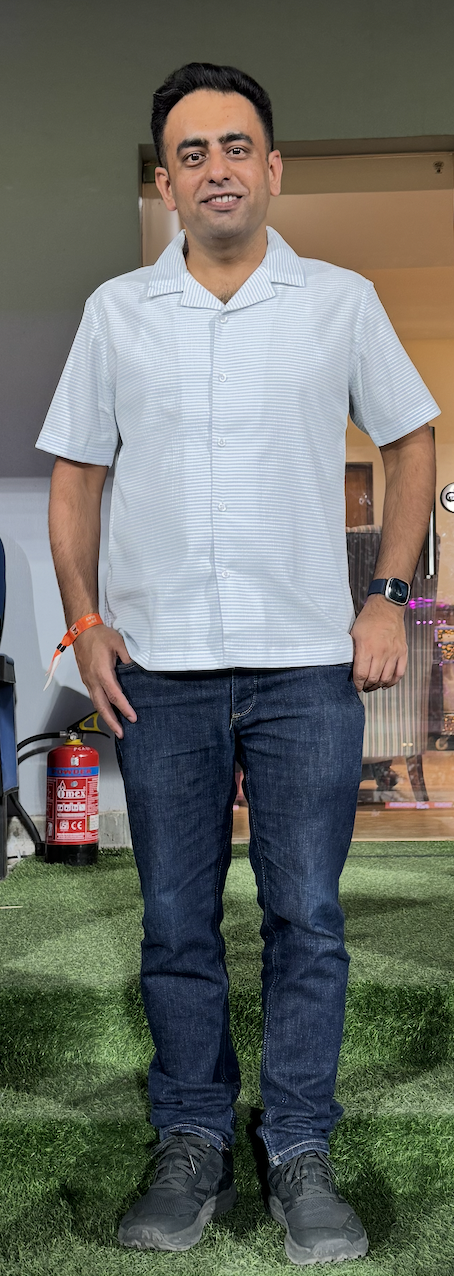
Every founder's story has a through-line. Mine is a question: what would healthcare look like if it actually measured whether patients got better? Here's how I got to the place where I decided to find out.
My training as an engineer gave me something that healthcare rarely has: a systems mindset. When I first encountered healthcare, I saw it the way an engineer sees a broken machine β not as a collection of individual problems, but as a system with flawed feedback loops. Outcomes weren't being measured. Data wasn't being used. Patients were optimised for compliance, not results. I didn't know it yet, but this lens would define everything that followed.
My first serious immersion in health was through genetics-based personalisation in nutrition and lifestyle medicine. The science was unambiguous: what works for one person's metabolism is actively counterproductive for another. Yet healthcare was β and mostly still is β built on population averages and one-size protocols. This was the first moment I understood that personalised care wasn't a luxury. It was the only rational approach. Any other model wasn't being rigorous. It was being lazy.
I worked across the spectrum of consumer health β healthy food systems, wellness technology, behaviour change platforms. Each space taught me the same lesson: people genuinely want to be healthy, but the tools they're given either don't work or don't fit their actual lives. Technology without outcomes data is just noise. Food without metabolic feedback is just hope. I kept returning to the same conclusion: the problem wasn't willingness. It was infrastructure that didn't measure the right things.
Having operated in the US, Canada, and India gave me a vantage point that most healthcare builders don't have. The US has world-class technology but a system architecturally designed around billing. Canada has universal access, but access is rationed by waiting β sometimes fatally. India has extraordinary clinical talent β doctors who are genuinely among the world's best β but almost no outcomes infrastructure. The most skilled physicians in India practise in a system that has never thought to measure whether their patients actually got better. I saw the same broken feedback loop in three different languages, three different funding models, three different political philosophies. The diagnosis was the same everywhere: nobody was closing the loop.
In 2021, I brought Dr. Anil Bhansali β one of Asia's foremost endocrinologists, former Head of Endocrinology at PGIMER Chandigarh for 20 years, and among the most cited physicians in the subcontinent β together with a world-class multidisciplinary team to build something India hadn't seen before: a hospital where every patient outcome is tracked, reviewed, and used to continuously improve care protocols. Gini is not designed to be the biggest hospital. It is built to be the most accountable one. That's a different ambition, and it attracts a different kind of doctor.
Gini Advanced Care Hospital is the clinical engine. But the bigger mission is the 100ers movement β a philosophy of intentional longevity built around functional age, not calendar age. The 100er asks a different question: not "how do I manage my illness?" but "how do I build a body and mind that stays active, independent, and joyful well into my 90s and beyond?" Starting with Chandigarh-Mohali-Panchkula. Expanding to 100ers Zones across India. Eventually, to the world.
This isn't about medical science, though science matters enormously. It's about a fundamental change in how we think about ageing β moving from passive acceptance to active design.
"I believe in a world where we don't just live longer β we live better every single day. Where ageing isn't something that happens to us, but something we actively manage. Where we stay active, independent, and joyful well into our 100s. This isn't a hope. It's a design problem. And design problems have solutions." β Gurjot Narwal
The question isn't how old you are. It's how old your body functions. A 70-year-old who climbs stairs without pain, thinks clearly, and lives fully independently has a better functional age than a sedentary 45-year-old with three chronic conditions accumulating quietly. Everything at Gini β every programme, every metric, every outcome we track β is ultimately aimed at one thing: preserving and improving functional age. This is the only number that tells the real story of how you're ageing.
What works for you is not the average of what works for a million people. Your genetics, your metabolism, your lifestyle, your psychology, your history β they make you a sample size of one. The future of medicine is not bigger protocols. It is better data about individual people. Every Gini patient gets a protocol built for them β informed by population evidence but calibrated to their specific biology and life. This is not premium care. It is the only scientifically defensible approach.
The healthcare system is paid per visit, per prescription, per procedure. There is no structural financial incentive to make you better β only to keep you coming back. Gini is built on the opposite model: we measure whether you actually got better. We publish our numbers. We review them monthly. We change protocols when the data says to. The goal β genuinely, structurally β is for our patients to need us less over time, not more. Our business model makes us more viable when our patients are healthier. That alignment changes everything.
Like Blue Zones β regions of the world where people naturally live longer β 100ers Zones will be intentional. Communities where people actively choose to age well. Where functional age is what's measured and celebrated, not calendar age. Where science, mindset, and systems combine to make living to 100 β fully, actively, independently β the expected outcome rather than the rare exception. We are starting in Chandigarh-Mohali-Panchkula. We plan to expand across India. Eventually, the goal is 100ers cities worldwide β places where the default is a long, healthy, independent life. Not a slow decline managed by a hospital. An active life, built with intention, from the day you decide to become a 100er.
Most hospitals in India don't know their diabetes control rate. They don't track whether their knee replacement patients are still walking pain-free at two years. They don't measure whether their PCOS patients conceived. They can't tell you their complication rates. This isn't because the doctors are bad β India has extraordinary clinicians. It's because nobody built the system to track it. At Gini, we built that system from day one. Every patient's outcome is in our database. We review our numbers every month. When something isn't working, we change the protocol β not quietly, not reluctantly, but as a matter of course, because the whole infrastructure is designed to surface the signal.
When I was working across healthcare systems in three countries, I kept encountering things that struck me as genuinely strange β not because the people running those systems were bad, but because what was broken had become invisible through normalisation. Problems that should have triggered alarm bells were treated as inevitable facts of life. The furniture was broken, but everyone had simply learned to walk around it.
Let me be specific. Three gaps in particular kept appearing, in different forms, in every system I observed. They are not peripheral problems. They are structural failures at the core of how healthcare is designed and rewarded.
The reason I'm writing this down is not to criticise the clinicians β who are, in many cases, working heroically within systems that were never designed to help them serve patients well. I'm writing it because understanding these gaps is what led to every design decision we made at Gini. This is where the hospital comes from.
If you're a patient reading this: these gaps affect you directly. If you're a clinician: you already know these are real. If you're a healthcare builder: this is the space that needs work.
In the US, the average large hospital system collects enormous volumes of billing data and almost no outcomes data. In India, this is even more stark. A physician sees a patient, adjusts a medication, and sends them home. Whether that adjustment worked β whether the patient's HbA1c came down, whether their knee functions better at six months, whether their chronic pain resolved β is largely unknown. Not tracked. Not reviewed. Not acted upon. The feedback loop that any functioning system requires simply doesn't exist. And without that feedback loop, even excellent clinicians are flying partially blind, making adjustments based on experience and intuition rather than a continuous data signal from their own patients. It is not rational. It is not science. It is the best available substitute when the infrastructure for real science doesn't exist.
The transaction model of healthcare creates a particular pathology: the encounter is complete when you walk out the door. The physician has done their job β the consultation happened, the prescription was written, the advice was given. What happens to the patient after that is, structurally speaking, outside the system's scope. There is no mechanism for follow-through. There is no way for the system to know that the patient didn't take the medication, or took it wrong, or took it and didn't respond, and needs a different protocol. The accountability horizon is the appointment. Everything beyond it is invisible. This is not negligence. It is an architecture problem β and architecture problems require architectural solutions.
Standard-of-care guidelines are built on population studies. This is appropriate β they represent the best available evidence for the average patient. The problem is that in clinical practice, the average patient doesn't exist. Every patient who walks in has a specific metabolic profile, a specific history, specific lifestyle constraints, specific psychological factors that affect adherence. The treatment that works for 60% of the population may be actively wrong for 40%. Without the infrastructure to identify which category a given patient belongs to β and to adjust the protocol accordingly β even evidence-based medicine is being applied with a degree of arbitrariness that no engineer would accept in any other field. Personalisation is not a luxury product. It is the logical conclusion of taking science seriously at the individual level.
A 100er is not someone who simply lives to 100. It's someone who decides β consciously, actively β to invest in the quality of every year, not just the quantity. Who measures their functional age and works to improve it. Who treats their body as the most important system they will ever manage. Who believes that staying independent, active, and mentally sharp into their 90s is not luck β it's the result of decisions made every decade before. Being a 100er is a choice you make in your 40s, 50s, and 60s. Not at 85 when the damage is already done. The door is open now.
I'm building Gini in public β publishing our outcomes, sharing what works and what doesn't, and trying to create a model that other hospitals and healthcare builders can learn from. The goal isn't to protect our approach. It's to spread it. If outcomes-based, personalised care becomes the industry standard in India, that's a win for everyone.
If you're working on healthcare innovation in India β whether you're a clinician, a builder, a researcher, or an investor β I'm always open to conversations. This is too important a problem for any one organisation to solve alone.
For medical appointments, please use the booking system above β I'm not a clinician, and I want you talking to the people who can actually help you.