✅ NABH Accredited  ·  10,000+ Surgeries  ·  Dr. Harjoban Singh

Shoulder Pain & Injury Treatment in Mohali — Arthroscopic Surgery Specialists

Led by Dr. Harjoban Singh — Fellowship-Trained Arthroscopic Surgeon

From rotator cuff tears to frozen shoulder to instability — we diagnose and treat the full spectrum of shoulder conditions. Most cases resolved without surgery. When surgery is needed, we use minimally invasive arthroscopic techniques for faster recovery.

📍 Mohali (SAS Nagar), Punjab · Serving Chandigarh Tri-City

💬 WhatsApp Us
🚨 Shoulder dislocated or cannot lift your arm at all? Call immediately: +91 82888 43800
10,000+
Surgeries Performed
95%+
Patient-Reported Good/Excellent Outcomes
Same Day
Diagnosis & Treatment Plan
NABH
Accredited Hospital
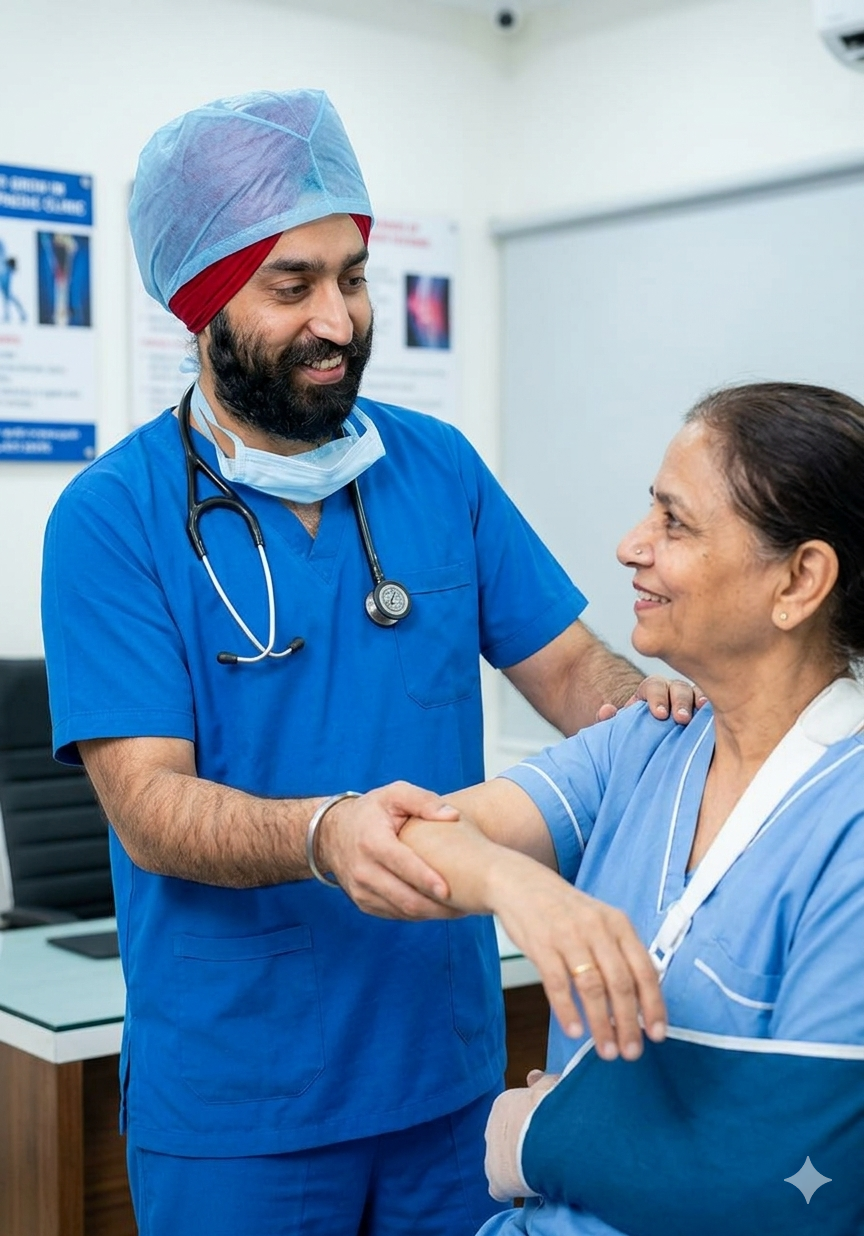
Dr. Harjoban Singh with patient, Arthroscopic Shoulder Surgeon at Gini Hospital Mohali

Conditions We Treat

From common shoulder pain to complex instability and tears — comprehensive shoulder care under one roof.

💪

Rotator Cuff Tear

Partial or full-thickness tear of the rotator cuff tendons. Most common cause of shoulder pain in adults. Mild/partial tears treated non-surgically; full-thickness tears repaired arthroscopically.

🧊

Frozen Shoulder (Adhesive Capsulitis)

Progressive stiffness and pain through 3 stages: freezing, frozen, thawing. Treated with physiotherapy, injections, and if unresponsive, arthroscopic capsular release.

Shoulder Dislocation & Instability (Bankart Lesion)

Recurrent dislocation, especially in young and active patients. Arthroscopic Bankart repair restores long-term stability and prevents recurrence.

🎯

SLAP Tear

Superior labrum tear from front to back. Common in overhead athletes and those with sudden falls. Arthroscopic repair restores function.

🏈

AC Joint Injury (Acromioclavicular)

Common in falls and contact sports. Graded 1–6. Most treated conservatively; severe cases require surgical reconstruction.

📌

Shoulder Impingement Syndrome

Rotator cuff tendons pinched under the acromion causing pain with overhead activity. First line: physiotherapy + injections. If unresponsive: arthroscopic subacromial decompression.

⚗️

Calcific Tendinitis

Calcium deposits in tendons causing acute severe pain. Treated with needling, injections, or arthroscopic removal.

🦾

Biceps Tendon Injury

Tear or tendinitis of the long head of biceps. Often treated alongside rotator cuff repair (biceps tenodesis or tenotomy).

Our Treatment Approach

A tiered approach that always tries the least invasive option first.

1

Tier 1 — Non-Surgical First Most Cases

Physiotherapy, injections, activity modification

For most shoulder conditions. Physiotherapy, anti-inflammatory injections (corticosteroid, PRP), activity modification. Most shoulder conditions improve without surgery. We exhaust non-surgical options before recommending the operating theatre.

Physiotherapy Corticosteroid Injections PRP Therapy
2

Tier 2 — Minimally Invasive Arthroscopy When Needed

Key-hole surgery, faster recovery, same-day or next-morning discharge

When conservative treatment fails or for structural injuries (full-thickness tears, instability). Key-hole surgery: 3–5 small incisions, faster recovery, less scarring, same-day or next-morning discharge for most procedures.

Full-Thickness Tears Bankart Repair Failed Conservative Treatment
3

Tier 3 — Open Surgery Rare

Reserved for complex reconstructions only

Reserved for complex reconstructions: massive irreparable tears, total shoulder replacement, revision surgery. Done when arthroscopy is not sufficient. Rare — the minority of cases.

Massive Irreparable Tears Total Shoulder Replacement Revision Surgery

Our philosophy: We believe surgery is a last resort, not a first recommendation. Most patients referred to us for 'surgery' end up managed non-surgically or with minimally invasive arthroscopy. The goal is the best outcome with the least intervention.

Shoulder Arthroscopy — What to Expect

A complete guide to key-hole shoulder surgery — before, during, and after.

What is Shoulder Arthroscopy?

Key-hole surgery using a tiny camera (arthroscope) and small instruments inserted through 3–5 small portals (5mm each). Diagnoses and treats in one procedure.

🔬
Arthroscopic Incisions
3–5 × 5mm
Small puncture incisions
🏥
Open Surgery Incision
10–15cm
Full incision required
Key Benefits
Less pain · Faster recovery · Lower infection risk · Same-day discharge

What can be treated arthroscopically at Gini Hospital:

✅ Rotator cuff repair
✅ Bankart repair (instability)
✅ SLAP repair
✅ Subacromial decompression (impingement)
✅ Frozen shoulder release (capsular release)
✅ Calcific deposit removal
✅ Biceps tenodesis / tenotomy
✅ AC joint resection
📋 Before Surgery — What to Do +
  • Pre-op assessment: blood tests, ECG, chest X-ray, shoulder MRI review — done 5–7 days before surgery
  • Stop blood thinners (aspirin, warfarin) as advised by Dr. Harjoban — typically 5–7 days before
  • Stop smoking at least 2 weeks before — affects healing significantly
  • Fast: nothing to eat or drink for 6–8 hours before surgery
  • Arrange someone to drive you home — you cannot drive after anaesthesia
  • Wear loose, button-front clothing on surgery day (easier to put on after)
  • Remove nail polish and jewellery before arriving
  • Inform the team of all medications and allergies
  • Understand how to wear your sling before surgery day — we'll show you
  • Home setup: ensure shoulder-height items are accessible, nothing requiring overhead reach
🏥 During Surgery — What Happens +
  • Duration: 45 minutes to 2 hours depending on procedure
  • Anaesthesia: General anaesthesia + interscalene nerve block (you will be completely asleep; the block controls pain for 12–18 hours after)
  • Arthroscope inserted through small portal — camera projects live on screen
  • Dr. Harjoban confirms final extent of injury under direct vision
  • Repair done through additional small portals using anchors, sutures, or shavers
  • Portals closed with 1–2 stitches each or steri-strips
  • Arm placed in sling before you wake up
  • Recovery room: 1–2 hours monitoring before ward transfer
  • Most patients go home same day or next morning
🗓️ After Surgery — Recovery Timeline +
First 24–48 Hours
  • Keep arm in sling at all times, including sleep
  • Ice pack over shoulder 20 minutes every 2–3 hours — do not apply directly to skin
  • Keep hand and fingers moving (make a fist, spread fingers) to prevent stiffness
  • Take pain medication as prescribed — do not skip the first dose
  • Keep wound dry — no shower for 48 hours, sponge bath only
  • Elevate arm slightly when lying (pillow under elbow)
  • Normal to have swelling and bruising — expected
Weeks 1–2
  • Dressing change at Day 2 and Day 7 — OPD or as instructed
  • Stitches removed at 10–14 days
  • Sling duration varies: rotator cuff repair 4–6 weeks · Bankart repair 3–4 weeks · decompression 1–2 weeks
  • Physiotherapy starts Day 3–5 — pendulum exercises only initially
  • No lifting with operated arm
Weeks 3–6
  • Progressive physiotherapy — range of motion exercises
  • Sling weaning begins (procedure-dependent)
  • No driving until sling is off and strength returns
  • Soft tissue work with physio
Weeks 6–12
  • Strengthening phase begins
  • Return to desk work: typically 6 weeks
  • Return to driving: 6–8 weeks
  • No overhead lifting or sports yet
3–6 Months
  • Return to sports: 4–6 months for most procedures
  • Return to manual labour / overhead work: 4–6 months
  • Full recovery: 6–12 months for rotator cuff repair · 4–6 months for Bankart/decompression
🚨 Warning Signs — Call Immediately:
  • ⚠️ Fever above 38°C
  • ⚠️ Wound red, hot, or discharging fluid
  • ⚠️ Arm going numb or turning cold
  • ⚠️ Sudden severe pain not controlled by medication

Your Shoulder Specialist

Dr. Harjoban Singh, Arthroscopic Shoulder Surgeon Gini Hospital Mohali

Dr. Harjoban Singh

Arthroscopic & Sports Medicine Surgeon
MBBS  ·  MS (Orthopaedics)  ·  Fellowship in Arthroscopy & Sports Medicine
  • 10,000+ surgeries performed — shoulder, knee, and sports injuries
  • Fellowship-trained in Arthroscopy & Sports Medicine
  • Specialises in arthroscopic shoulder and knee surgery, joint preservation
  • Languages: Punjabi, Hindi, English
"Most patients I see are worried they need surgery. My first goal is always to find the least invasive solution that gives you back full function."

Why Choose Gini Hospital for Shoulder Surgery?

Six reasons patients from across the Chandigarh tri-city region choose us for shoulder surgery.

🎯

Dedicated Arthroscopy Theatre

Purpose-built arthroscopy OT with high-definition 4K arthroscopy equipment. Sterile environment optimised for key-hole procedures.

🏥

In-House Physiotherapy

Seamless post-op care from Day 3. Physiotherapy team works directly with Dr. Harjoban's protocol — no referrals to outside centres.

NABH Accredited

National accreditation for patient safety, infection control, and care quality. Same standards as India's top hospitals.

💳

Cashless Insurance

CGHS, ECHS, and 32+ private insurance plans accepted. We handle all pre-authorisation and paperwork.

📊

95%+ Good/Excellent Outcomes

Patient-reported outcomes across arthroscopic shoulder procedures. Return to sport and work tracked at 3, 6, and 12 months.

🏠

Same-Day Discharge

Most arthroscopic procedures allow same-day or next-morning discharge. Back home, back to recovery faster.

Costs & Insurance

Transparent pricing. Cashless insurance for most procedures.

Our cost philosophy: Shoulder surgery costs vary significantly depending on the procedure, complexity, and implants used. We believe in transparent, honest pricing — contact us for a detailed estimate based on your specific condition and MRI.

Service Cost
OPD Consultation (Dr. Harjoban Singh) ₹700
Arthroscopic Shoulder Surgery From ₹45,000 upwards depending on procedure and complexity
Pre-op Assessment (bloods, ECG, X-ray) Included in surgery package
Physiotherapy (post-op) As per sessions required
Insurance Coverage
✅ Most arthroscopic shoulder surgeries covered by insurance (CGHS, ECHS, major private plans)
✅ 32+ insurance partners — cashless facility available
✅ Pre-authorisation handled by our team
✅ Contact us to verify your specific plan and coverage

Frequently Asked Questions

Everything you need to know about shoulder treatment and surgery at Gini Hospital.

How long will I be in a sling after arthroscopic shoulder surgery? +
Depends on the procedure. Rotator cuff repair: 4–6 weeks. Bankart repair: 3–4 weeks. Subacromial decompression or calcific removal: 1–2 weeks. Dr. Harjoban will give you a specific timeline based on your surgery.
Can frozen shoulder be treated without surgery? +
Yes, in most cases. Physiotherapy and corticosteroid injections resolve frozen shoulder in the majority of patients (freezing and early frozen stage). If 3–6 months of conservative treatment fails or in the late frozen stage, arthroscopic capsular release gives excellent results with rapid improvement.
When can I return to work and driving after shoulder arthroscopy? +
Desk work: typically 4–6 weeks. Driving: when your sling is off and you have sufficient strength — usually 6–8 weeks. Manual labour and overhead work: 4–6 months. Specific timelines depend on the procedure.
Is arthroscopic shoulder surgery covered by insurance? +
Yes. Most arthroscopic shoulder procedures are covered under CGHS, ECHS, and major private insurance plans. We offer cashless facility with 32+ insurance partners and handle all pre-authorisation paperwork.
How do I know if I need surgery or just physiotherapy? +
An MRI and clinical examination with Dr. Harjoban will determine this. Key indicators for surgery: full-thickness rotator cuff tear, recurrent dislocation (Bankart), failed 3–6 months of conservative treatment. Most partial tears, impingement, and early frozen shoulder improve without surgery.
What is the difference between arthroscopic and open shoulder surgery? +
Arthroscopy uses 3–5 small (5mm) portals and a tiny camera — same-day discharge, less pain, faster recovery, lower infection risk. Open surgery uses a 10–15cm incision and is reserved for complex reconstructions (massive tears, total shoulder replacement) that cannot be done arthroscopically.
How long does shoulder arthroscopic surgery take? +
45 minutes to 2 hours depending on the procedure. Simple decompression or biceps tenotomy: 45–60 minutes. Rotator cuff repair or Bankart repair: 1–2 hours.
Will I need a blood transfusion for shoulder surgery? +
No. Arthroscopic shoulder surgery has minimal blood loss. Blood transfusion is not required for standard arthroscopic procedures.

Ready to Get Your Shoulder Assessed?

Same-day appointments available. Free assessment. Led by Dr. Harjoban Singh — 10,000+ surgeries.

📞 Call 0172 4120100
Chat with us